Educational Resources
Begin Learning now!
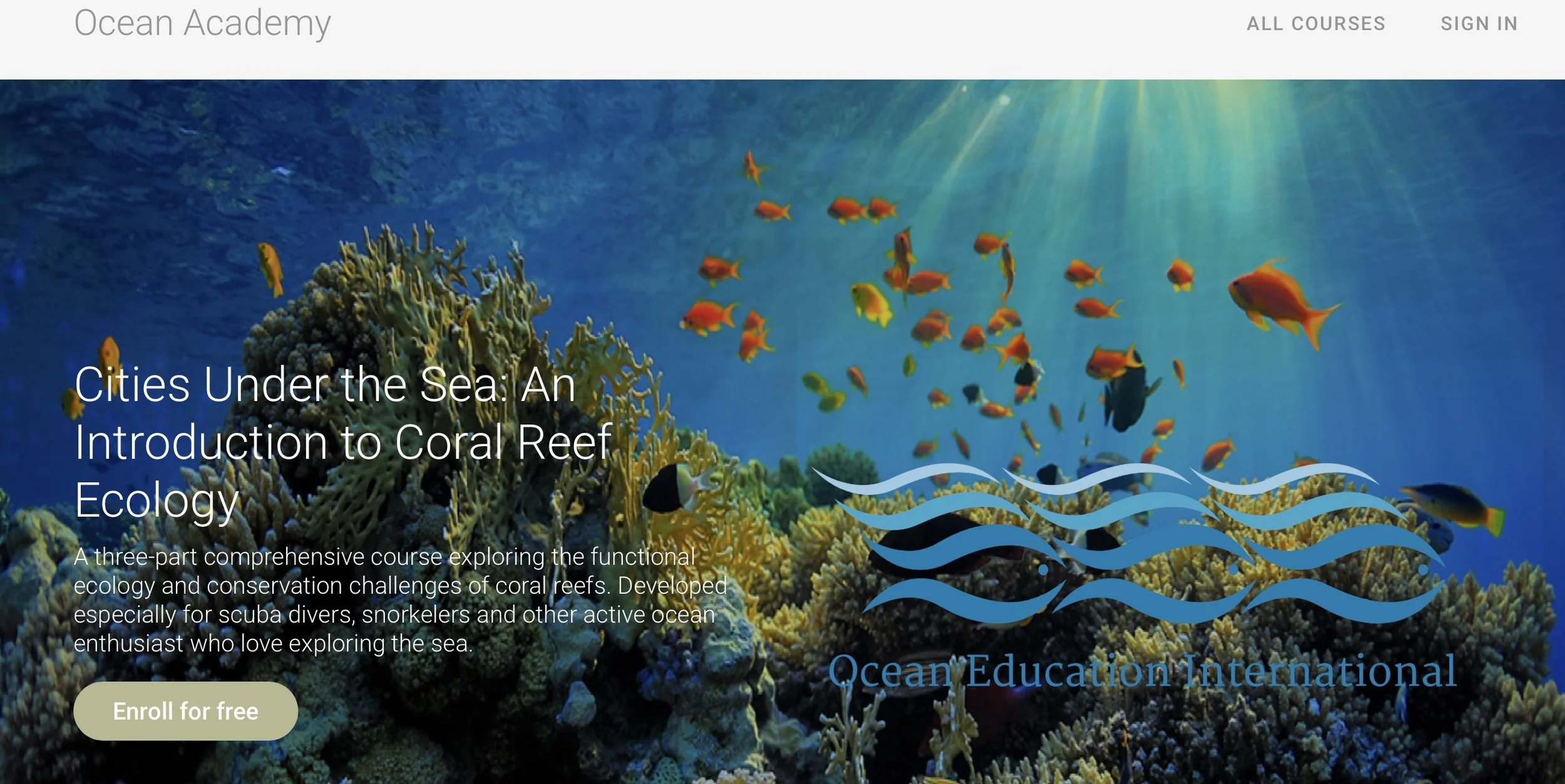
Cities Under the Sea
Dr. Brylske’s three‑part online course is designed primarily for scuba divers, snorkelers, and ocean enthusiasts who want a deeper understanding of how coral reefs function and why they matter. It covers the basics of coral reef ecology (how reefs work, where they form, and their key organisms), coral reef fish ecology (food webs, morphology, and feeding strategies), and the major threats facing reefs, including pollution, overfishing, disease, and climate change. Throughout the course, it emphasizes real-world conservation issues and practical actions individuals can take to help protect reefs, supported by structured lessons and quizzes to reinforce learning.
Merging Business & Environment
This is a long-form video lecture created to support OEI’s sustainable dive tourism courses, It explains why the dive and travel industries must move toward sustainability, covering coral reef decline, global tourism trends, over-tourism, and the shift toward experiential, sustainability-focused travelers. The lecture introduces concepts such as sustainable tourism, the triple bottom line (people, planet, profit), values‑based marketing, and practical five-step pathways for dive businesses to become more environmentally responsible and competitive. It showcases real-world examples of destinations, resorts, liveaboards, and brands successfully integrating sustainability, and highlights tools like Green Fins, carbon offset programs, and major sustainability reports. Overall, the course positions sustainability not as altruism but as sound business practice that modern divers and travelers increasingly expect.
Doing the Right Thing: A Guide to Sustainable Dive Practice
This is a professional-development lecture for dive professionals (and serious divers) that supports OEI’s sustainable dive tourism course. It focuses on how to reduce diver and snorkeler impacts on reefs and marine life, covering ethical wildlife interaction (and why feeding/harassing animals is harmful), anchoring vs. moorings, effective pre‑dive briefings, photographer behavior, and evidence from diver‑impact studies. A major portion is devoted to improving training practices—especially buoyancy, trim, propulsion (e.g., frog kick), and “stop and tuck” skills—so divers achieve true mastery and cause less damage. The lecture also addresses broader sustainability choices (seafood consumption, reef‑safe sunscreen, souvenirs, deforestation links) and highlights tools like Green Fins diver/guide e‑courses and local programs (e.g., Florida Keys Blue Star) as practical frameworks for best practice.
Free Online Courses & Video Lectures
Sustainable Dive Leader
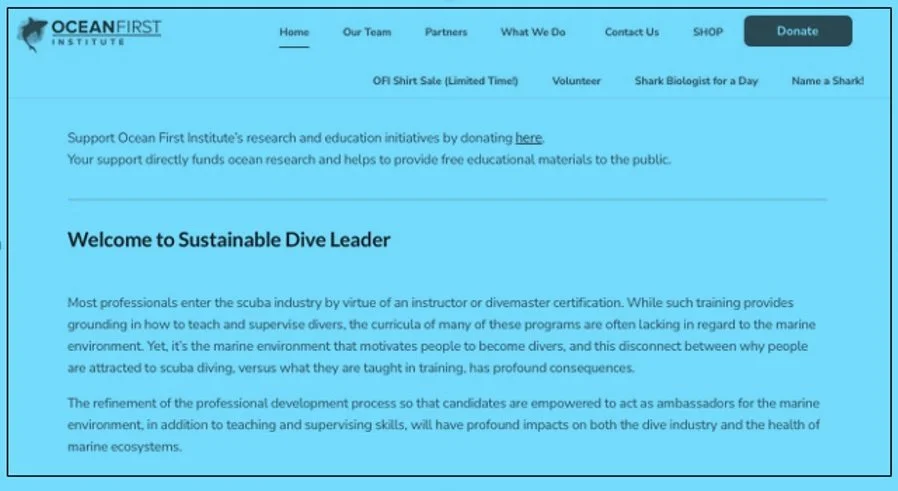
The Ocean First Institute’s Sustainable Dive Leader course is an online professional development program designed to help instructors and divemasters integrate marine ecology and sustainability into their teaching and leadership. It addresses a common gap in traditional dive training by focusing on the marine environment—the primary reason people learn to dive—and how tourism impacts ocean ecosystems. Across five chapters, it covers the scuba industry’s structure, the impacts and principles of sustainable tourism, understanding diver motivations, and turning environmental knowledge into practical, business-aligned action. The course is authored by Dr. Brylske.
Dive Industry Insights from Alex Brylske on Sustainable Marine Tourism
This episode of Marketing Minutes from Scuba Diving Industry Magazine features Dr. Alex Brylske discussing his company Ocean Education International and its mission to make marine tourism a positive force for ocean conservation. Brylske explains his long career arc—from early dive education and watching reefs decline, to returning to graduate school in marine science and building courses on marine ecology and sustainable tourism—culminating in OEI’s business‑to‑business focus as a “force multiplier” by training dive pros rather than the general public. He outlines OEI’s key offerings, including the intensive ECO PRO course (covering coral reef ecology, environmental interpretation, citizen science, shark ecology, and reef‑health assessment dives) and the free online “Sustainable Dive Leader” course developed with Ocean First Institute. The conversation also highlights his book Beneath the Blue Planet: A Diver’s Guide to the Ocean as a concise environmental knowledge base for dive professionals, intended to fill the common gap in environmental content in standard diver training.
Critical Difference Between Satisfied and Enthusiastic Scuba Divers
This Immersion Zone podcast reviews Dr. Alex Brylske’s framework (via the Business of Diving Institute) for moving beyond merely “satisfied” scuba customers to creating truly enthusiastic divers. The hosts explain that traditional dive operations focus too much on selling courses, c‑cards, and gear, while neglecting the core underwater experience that creates a deep sense of connection or “sense of place.” Drawing on Brylske, they distinguish education (transmitting facts) from interpretation (using ideas and feelings to inspire appreciation and personal meaning), and show how good interpretation can be delivered in short, 90‑second “micro messages” and teachable moments on the reef. They outline a five‑step reaction chain—understanding, curiosity, reflection, care about, and care for the environment—and illustrate it with a detailed parrotfish example that links ecology to divers’ everyday choices. The episode concludes that dive pros who learn to be interpreters, not just instructors, are the ones who turn casual customers into passionate, conservation‑minded enthusiasts.
Secrets of the Coral Reef
The program explores the “shifting baseline” phenomenon and aspects of coral ecology rarely addressed. It highlights how science is expanding its understanding of a wide range of issues from coral physiology to resource management. Also addressed are ongoing and emerging threats to coral reefs and how divers can contribute to successful marine conservation efforts.
Podcasts
Deconstructing The Diving Industry
In this episode of The Dive Locker Podcast, host Tec Clark talks with Dr. Alex Brylske of Ocean Education International about “deconstructing” the diving industry to understand why it is in a slight long‑term decline. Drawing on Brylske’s 40 years of attending the DEMA Show, they explore both macro and micro problems in the industry, emphasizing that many dive operations are still run as linear, product-focused businesses in a world that now rewards non‑linear, experience‑driven models. A major theme is the importance of genuine human connection and clearly understanding the “why” of being a dive professional, echoing concepts from Simon Sinek’s famous TED Talk on purpose-driven leadership. Alex argues that for dive centers to survive and grow, they must evolve toward travel- and experience-centered offerings and more value-added eco‑focused training such as his unique ECO PRO course.
Interpreting Coral Reef Ecology In A New Way
In this episode of The Dive Locker Podcast, host Tec Clark talks with Dr. Alex Brylske about how dive professionals can interpret coral reef ecology more effectively for their students and customers, without needing a marine biology degree. They highlight Brylske’s program, Coral Reef Ecology for Divers, as a practical way for pros to deepen their understanding of coral reefs so they can better “manage their inventory” of underwater life and get divers excited about more than just the big animals. The discussion contrasts simple “education” with true interpretation of the underwater world. It situates this within Brylske’s long background in diver education, including his work with PADI, Dive Training Magazine, and his current role at Ocean Education International, which focuses on sustainable dive tourism.
Seminars
These one-hour programs are presented personally by Dr. Brylske
and can be delivered either live or via Zoom.
Contact us for details and available dates.
Secrets of Coral Reef Fish(es)
Expanding on the seminar Secrets of the Coral Reef, this program is devoted exclusively to understanding some rarely addressed aspects of coral reef fishes. The discussion explores how “form drives function” and how this relates to behavior. Also addressed are recent insights into fish reproductive biology and the profound effects overfishing can have on coral reef food webs.
What Makes a Shark a Shark?
This seminar examines why sharks are such a unique group of fish. Topics include why sharks don’t have bones, the distinct way they’ve adapted to living in seawater, why some sharks are “warm-blooded,” their amazing electro-sensitivity, and their mammalian-like reproductive mode.
The Lion’s Roar
The invasion of the Atlantic by the Pacific-native lionfish is having a significant negative environmental impact throughout the greater Caribbean region. This program explores the status, the latest research findings, and how resource managers and tourism interests are responding to this crisis.
The Reef at Night
Revealing the hidden life of coral reefs after dark, this program introduces divers to the dramatic “changeover” from daytime to nocturnal marine communities and the predators and grazers that emerge at twilight. Learn how sharks and other hunters see in low light, and how corals, fishes, and invertebrates use bioluminescence and biofluorescence in surprising ways—from camouflage and sunscreen to attracting prey and symbiotic algae. The program explains the science behind fluorescence, including GFPs and specialized lighting systems, and shows how these tools are used in cutting-edge reef research and restoration. This visually stunning, science-based program transforms night diving into a glowing window on reef ecology and conservation.
The Green Fins Dive Guide
e-Course
A free online training program for professional dive guides and instructors (Rescue level and above) that teaches how to minimize diver impacts on coral reefs by following Green Fins’ environmental standards. It consists of three modules covering background on coral reefs and the Green Fins initiative, best practices above water and on the boat, and concrete guidance on managing yourself and your divers underwater. Learners must score 100% on short tests after each module and can complete the course in roughly half a day, at their own pace. A personalized certificate, valid for two years, is available for US$25, with a scholarship fund for guides from lower-income countries who cannot afford the fee.
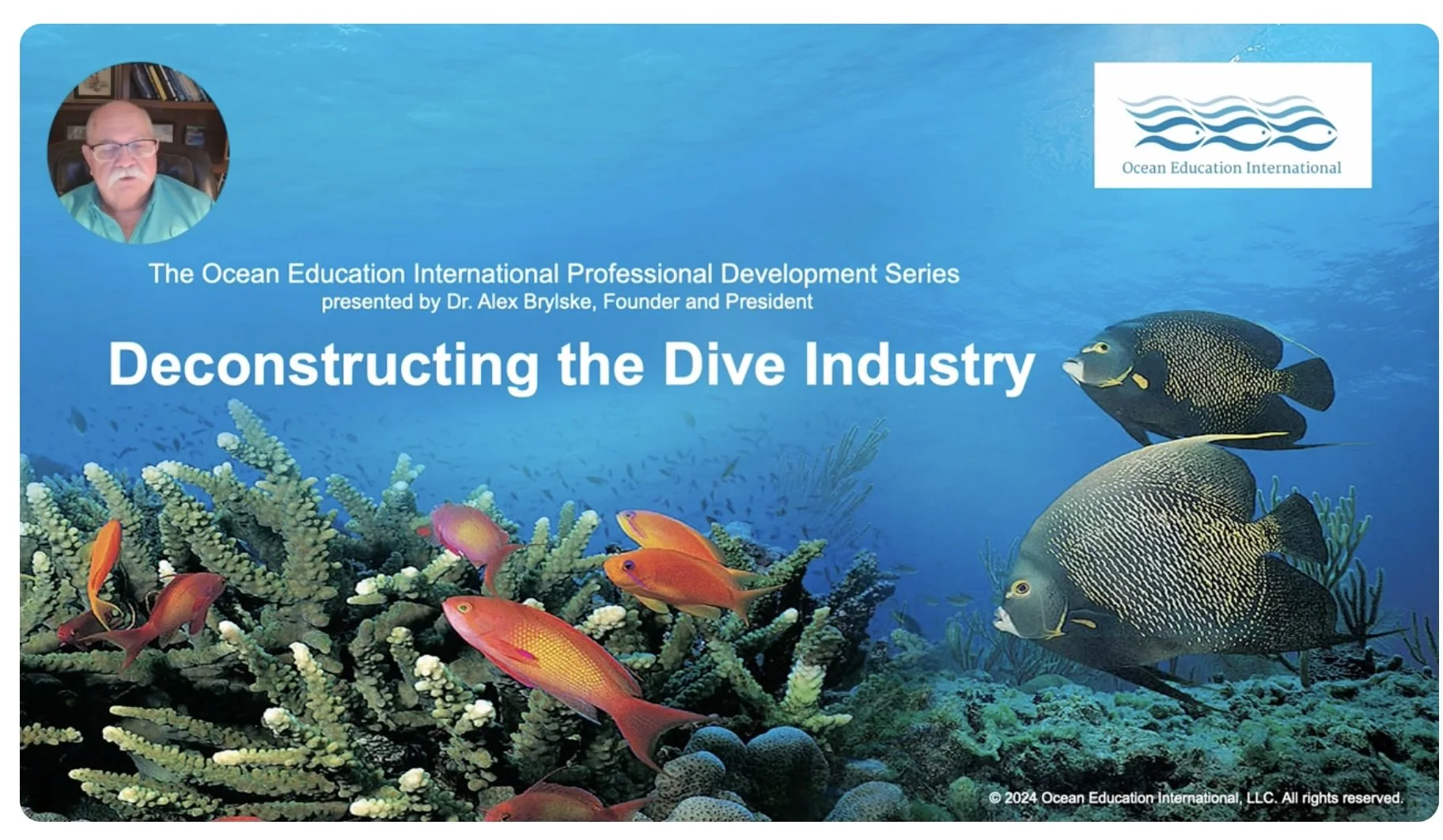
Deconstructing the Dive Industry
This is a video lecture that supports OEI’s sustainable dive tourism courses. It is aimed at current and aspiring dive professionals who want a more honest, big-picture understanding of why the dive industry is struggling—especially in North America—and how it must change. The lecture critiques the traditional “80s model” focused on gear sales and weak training, highlights data on declining core participation and poor environmental education, and argues for shifting to an experience‑centered, sustainability‑driven business model. It introduces concepts like “occasional vs. core” divers, Blue Ocean Strategy, building your own professional brand (especially as a non–brick-and-mortar instructor), and using Simon Sinek’s “Start With Why” framework to redefine what business you are really in. Overall, it is both a diagnosis of the industry’s structural problems and a roadmap for dive pros to reposition themselves as adventure travel professionals who create meaningful, environmentally informed experiences.
Free Sustainability Tools & Guidelines

Selected Articles by Dr. Alex Brylske
Published in Scuba Diving Industry™ Magazine
Ocean Education International collaborates with training agencies, operators, and NGOs worldwide to advance ocean literacy and sustainable dive tourism. The following selected articles by OEI founder Dr. Alex Brylske, who is also Scuba Diving Industry Magazine’s Sustainability Editor, provide background reading on the ECO PRO framework, the Blue Economy, applied marine science for dive professionals, and best conservation practices.
ECO PRO & Pro Training
These articles outline OEI’s approach to building “ECO PROs”: dive professionals whose environmental competence, teaching skills, and leadership are central to their role—not add‑ons. They are particularly relevant for agencies, resorts, and training directors designing or updating professional‑level curricula.
Redefining the Dive Professional: How to Create ECO PROs
Read article
This article expands the traditional dive‑professional profile to include environmental competence as a core requirement. It outlines a pathway for developing “ECO PROs” who deliver high‑quality experiences while meeting modern expectations for sustainability.
What is a ECO PRO & How Do They Help Our Industry?
Read article
This article defines the ECO PRO concept and links it to tangible business benefits. It explains how stronger environmental literacy and leadership enhance brand differentiation, customer loyalty, and regulatory goodwill.
Training a Complete Diver: Attitude is Everything
Read article
Diver education is framed as shaping attitudes and behavior, not just skills and certifications. This discussion offers strategies for instructors to cultivate responsibility, situational awareness, and environmental ethics in every course.
Beyond Blowing Bubbles: How Instructors Can Be the Missing Link
Read article
This article positions instructors as the critical bridge between marine science and diver behavior. It highlights how routine teaching moments can build “ocean literacy” and convert recreational divers into engaged ocean advocates.
The Great Disconnect: A Plea for Better Environmental Education
Read article
This article critiques the industry’s reliance on instructor certification alone as a measure of professional readiness. It calls for deeper environmental and social content in training if the dive sector is to meaningfully support marine conservation.
Don’t Be “Just Another Instructor”
Read article
This piece speaks directly to instructors about professional identity and differentiation. It argues that deep educational quality, environmental credibility, and mentorship are what truly distinguish an outstanding dive educator.
Blue Economy, Tourism & Policy
This section focuses on the economic and policy context for dive tourism. These articles are useful for destination managers, government agencies, NGOs, and businesses interested in aligning dive tourism with Blue Economy and regenerative development goals.
Redefining Dive Tourism: There is no "Planet B" – A Call for a New Paradigm
Read article
Introducing a Blue Economy lens to the dive sector, this article calls for a shift from volume‑driven tourism to regenerative models that restore marine ecosystems and coastal communities. It positions dive tourism as a proving ground for how profitable businesses can also drive systemic ocean recovery.
Redefining Dive Tourism: Understanding the True Nature of Our Business
Read article
This article reframes dive operations as part of a broader experiential and service‑based tourism system. It shows how adopting this perspective supports more resilient, higher‑value, and more sustainable business models.
Charting the Blue: The Role of Dive Tourism in the Ocean Economy
Read article
Drawing on new global valuation research, this article demonstrates that dive tourism is a significant component of the ocean economy. It translates technical findings into practical insights for destinations and operators seeking to align growth with ocean stewardship.
Why the Scuba Industry Needs More Self-Generated Data
Read article
This article explains why the dive sector must move beyond anecdote and fragmented tourism statistics toward robust, self‑generated data. It outlines how better evidence strengthens the industry’s voice in economic planning, climate policy, and marine conservation.
Understanding Blue Carbon: What It Means for Ocean Conservation
Read article
This article explains blue‑carbon ecosystems—mangroves, seagrasses, and tidal wetlands—and their role in climate mitigation. It shows how incorporating blue‑carbon thinking into marine tourism can unlock new arguments and mechanisms for coastal protection.
Leveraging Carbon Calculators for Sustainable Dive Travel
Read article
This introduces carbon calculators as a concrete tool for reducing the footprint of dive travel. It demonstrates how operators can embed these tools into trip planning and communication, turning climate responsibility into part of the customer experience.
The Role of Sustainability in Modern Diving Practices
Read article
This article unpacks “sustainability” as an operational framework rather than a marketing slogan. It outlines how environmental impact, social responsibility, and economic resilience can be integrated into daily decision‑making for dive operations.
Science for Dive Professionals
These articles translate key concepts from marine science into practical knowledge for instructors, guides, and dive leaders. They are designed to help professionals interpret what divers see underwater and communicate complex processes in clear, engaging language.
The Chemistry of the Sea: What Every Dive Pro Should Know
Read article
This piece distills key aspects of seawater chemistry into accessible language for instructors and guides. It links pH, nutrients, and pollutants to the changes divers see on reefs, equipping professionals to communicate ocean science more effectively.
Oceanography for Dive Pros: Earth in Motion
Read article
This introduces essential physical oceanography—currents, tides, and circulation—as core knowledge for dive leaders. It shows how understanding “Earth in motion” improves safety, trip planning, and environmental interpretation.
Understanding Coral Reef Bleaching: Latest Causes and Trends 2025
Read article
This article synthesizes current science on coral bleaching, from global climate drivers to local stressors. It provides dive professionals with a balanced narrative they can share with guests—acknowledging the severity of impacts while highlighting resilience and solutions.
Addressing the Challenges of Soft Coral Invasions
Read article
Focusing on soft‑coral expansion in the Caribbean, this article explores ecological drivers and implications for dive tourism. It helps professionals interpret rapidly changing reefscapes and engage constructively in local management discussions.
It’s the Play, Not the Actors: Education and Coral Reef Ecology
Read article
Using a theater metaphor, the article encourages divers and educators to focus on ecological processes rather than only charismatic species. It also offers practical interpretive tools to make complex reef dynamics understandable to non‑scientists.
Conservation, Ethics & Responsible Practice
The articles in this section focus on how everyday choices—what we eat, what we buy, how we dive, and how we communicate—affect ocean health. They provide practical guidance for building truly responsible dive operations and experiences.
Diver’s Guide to Sustainable Seafood Choices for Ocean Conservation
Read article
Building on his widely shared “Don’t Be the Grouper Sandwich Guy” essay, the article provides a practical framework for divers and operators to assess seafood choices. It analogizes running a restaurant to reef health and fisheries sustainability.
Eco-Friendly Sunscreen for Divers: Protect the Ocean and Your Health 2025
Read article
This piece examines the science and marketing claims behind “reef‑safe” sunscreens. It offers clear, evidence‑based guidance for dive businesses on recommending products that protect both coral reefs and human health.
The Debate on Shark Feeding in Diving Practices
Read article
This reviews the ecological, safety, and ethical dimensions of baited shark dives. It proposes a balanced framework that destinations and operators can use to evaluate shark‑feeding practices and communicate their policies transparently.
Why Take Bad Pictures? The Role of Photography in Marine Conservation
Read article
Combining visual communication and conservation, this article explains how high‑quality, ethical underwater imagery advances ocean protection. It challenges professionals and guests to use photography as a storytelling tool that supports, rather than harms, marine life.
Reef-World’s Vision: An Interview with Chloe Harvey on Marine Conservation
Read article
In this in‑depth interview, Dr. Brylske speaks with Reef‑World Executive Director Chloe Harvey about Green Fins and best practices for marine tourism. Together they translate global conservation standards into practical steps dive businesses can implement.