ECO PRO
Our Signature Program in Sustainable Dive Tourism
A New Standard for Profitable, Sustainable Dive Tourism
The Tourism Tide Has Turned
For tourists, there was a time when 'sun and fun' was enough. Not anymore. Today's travelers—especially Millennials and Gen Z—seek purpose, authenticity, and impact. Globally, 70% of Millennial and Generation Z travelers now prioritize environmental sustainability when choosing destinations, and adventure travelers are willing to pay premium prices for experiences that demonstrate genuine conservation commitment. And this is especially true with divers. Increasingly, they are choosing operators who protect what they love and who make every dive meaningful. In this new market, the operators who adapt will lead. Those who don't will quietly fade away amid the waves of change.
This isn't a prediction—it's already happening. Younger divers travel more, conduct more research, and reward brands that align with their values. They want to learn, contribute, and return home changed. And they are willing to pay for it. The question is simple: will your business be the one they choose?
Adaptation here isn't cosmetic—it's a redefinition of value. Guests want to see your stewardship before they see the reef: on your website, in your briefings, and in the way your team behaves on deck and underwater. When they feel that integrity, they book faster, stay longer, and tell the world.

Do Well By Doing Good
ECO PRO is built on a powerful truth: sustainability sells. Protecting coral reefs, elevating your guides, and educating your guests isn't a cost center—it's a profit engine. When you transform routine dives into meaningful experiences, you don't just reduce environmental risk—you increase guest satisfaction, repeat visitation, and average spending. This is an example of capitalism and conservation working together.
We equip your team to deliver conservation-minded adventures that are safer, richer, and more marketable. You'll signal leadership with International Standards Organization-aligned practices (ISO 21416/21417) and Green Fins principles, and you'll make that leadership visible—on your website, on your boats, and in every briefing. Your story becomes a reason to book. Your standards become your competitive edge.
The outcome is a business that outperforms because it out-cares: higher review scores, stronger word of mouth, and premium experiences that justify premium pricing. Doing good becomes the most persuasive sales strategy you have.

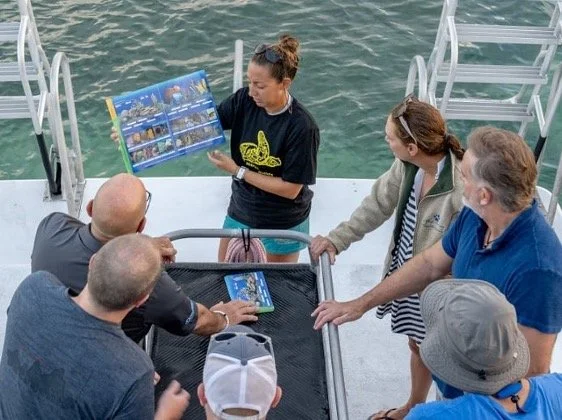
From Briefings to Belief: The Experience Guests Remember
What guests remember isn't the checklist—they remember the story. Your story that brought the reef to life. The route that avoided fragile corals and revealed a cleaning station at dusk. The guide who showed them herbivores at work and explained why reef-safe sunscreen matters. The moment they became a steward, not just a spectator.
ECO PRO turns guides into interpreters, dives into narratives, and customers into advocates. Education becomes the most memorable part of the trip—without feeling like a class. We call it selling travel through education. Your guests call it the best dive of their lives.
When your team connects ecology to emotion, divers don't just see the reef—they see their role in its future. That is loyalty you cannot buy with discounts.
What Changes With ECO PRO?
This is not another “specialty” certification to hang on a wall. It's a transformation of how you operate, what you offer, and how your market perceives you.
Your product: From generic fun dives to curated, conservation-focused experiences that command premium pricing.
Your people: From supervisors to storytellers—professionals trained to interpret ecology, manage impacts, and delight guests.
Your practice: From good intentions to ISO and Green Fins-aligned standards that reduce risk and create visible credibility.
Your brand: From "nice shop" to regional leader in sustainable marine tourism—easy to find, easier to trust.
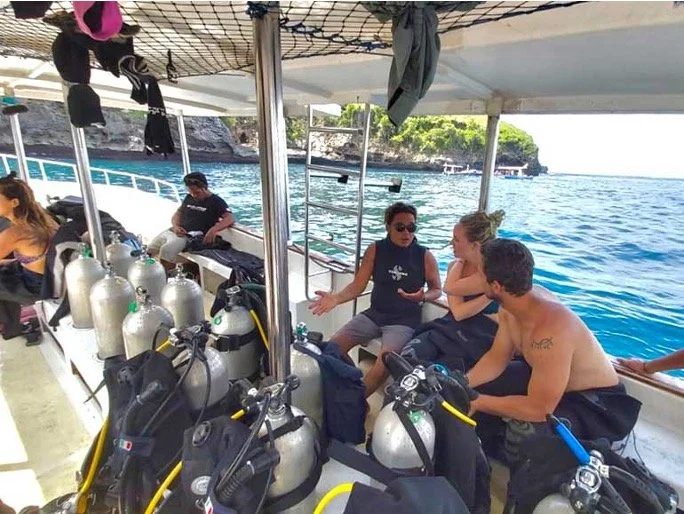
Proof You Can Bank On
Impact you can measure: fewer coral contacts, better buoyancy and trim, higher mooring-buoy use, and consistent adoption of best practices after training.
Experience you can feel: reviews that cite learning, care for the reef, and guides who made the ocean come alive.
Revenue you can see: premiums for conservation-themed dives, higher repeat visitation, stronger shoulder seasons with education products, and internships.
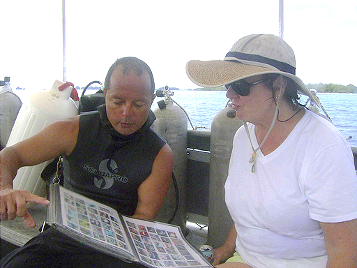
Why Operators Choose ECO PRO
It aligns values with value: guests feel good—and spend more—when their experience does good.
It de-risks operations: standards reduce environmental and reputational risk while improving quality control.
It differentiates your brand: ISO alignment and Green Fins principles signal leadership that travelers and partners trust.
It builds your team: staff pride and retention increase when pros become interpreters and stewards.
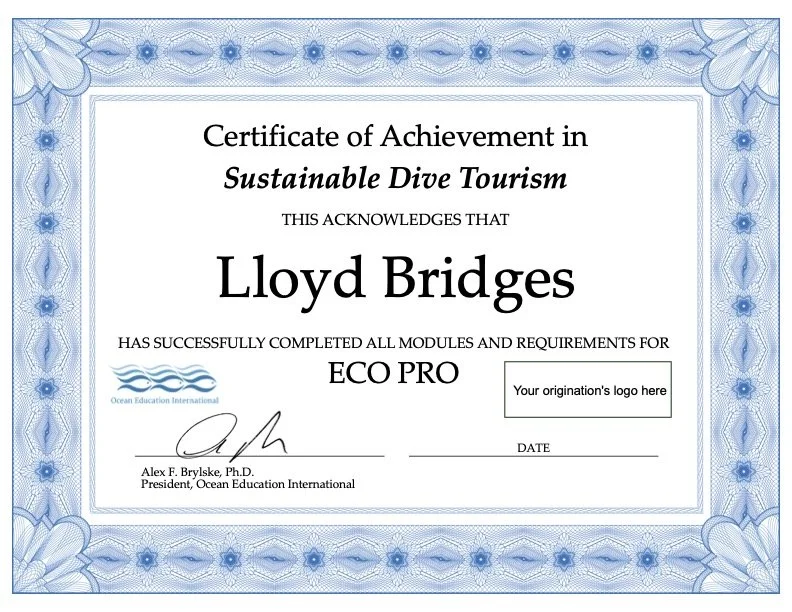
Act Now…Or Fall Behind
Markets don't wait. The operators who claim this ground first will own it—partnering with NGOs and universities, winning features in sustainability-focused media, and becoming the 'must-dive' choice for the next generation. The rest will compete on price until there's nothing left to discount.
If you believe reefs are worth protecting—and that your business should thrive because of it—ECO PRO is your path forward. Lead with substance. Sell with meaning. Deliver dives that change behavior, not just air pressure. The future of dive tourism belongs to those who make every dive matter.
How it Works
ECO PRO is delivered in two phases designed for minimal disruption,
maximum impact, and immediate marketability.
Phase 1 — Online, Self-Paced (Start Anytime, No Downtime)
Your staff can begin immediately—no need to pull them off the schedule. Modules are mobile-friendly and organized into short lessons that fit around boat runs and shop hours.
Components:
Module 1:Sustainable Dive Leader is a professional development program designed to help instructors and divemasters integrate marine ecology and sustainability into their teaching and leadership. It addresses a common gap in traditional dive training by focusing on the marine environment—the primary reason people learn to dive—and how tourism impacts ocean ecosystems. Across five chapters, it covers the structure of the scuba industry, the impacts and principles of sustainable tourism, understanding diver motivations, and turning environmental knowledge into practical, business-aligned action.
Module 2: Cities Under the Sea: An Introduction to Coral Reef Ecology is a three‑part, 17-lesson course designed primarily for scuba divers, snorkelers, and ocean enthusiasts who want a deeper understanding of how coral reefs function and why they matter. It covers the basics of coral reef ecology (how reefs work, where they form, and their key organisms), coral reef fish ecology (food webs, morphology, and feeding strategies), and the major threats facing reefs, including pollution, overfishing, disease, and climate change. Throughout the course, it emphasizes real-world conservation issues and practical actions individuals can take to help protect reefs, supported by structured lessons and quizzes to reinforce learning.
Module 3: Green Fins Dive Guide e-Course is a program for dive professionals focused on helping guides and instructors prevent diving-related damage to coral reefs by applying the Green Fins environmental standards and Code of Conduct during day-to-day operations. The course is framed around a dive guide’s ability to positively influence guest behavior and “protect coral reefs one dive at a time,” and is structured as three modules: 1) background on coral reefs and the Green Fins initiative, 2) best-practice actions above water/on the boat, and 3) guidance for below-water practices, including how to manage both yourself and your divers. Learners complete a short test after each module and must score 100% on each module exam to pass (retakes allowed). A personalized certificate is optional for $25 (valid for two years), with proceeds supporting Green Fins’ work.
Upon completing this phase, your staff will have a firm understanding of global and regional sustainability challenges, be able to identify human impacts, implement mitigation strategies, and be fully prepared for practical application during Phase Two.
Built-in tools include briefing scripts, route-planning checklists, signage, and templates you can drop straight onto your website and boats.
Phase 2 — Live, In-Person (scheduled to avoid disruption of operations).
We come to you. Your team practices on your sites, with your boats and your guest flow. This is where standards become habits and stories become signature experiences.
Components:
Module 4: Sustainable Dive Tourism Trends, Attitudes, and Marketing explores the critical intersection of scuba diving and environmental sustainability. This presentation examines evolving consumer attitudes toward conservation and sustainability. The module showcases real-world examples of how governments, corporations, and dive operations worldwide are implementing sustainable practices, providing dive professionals with a roadmap for transforming traditional business models into values-based, conservation-focused operations that align with what modern divers truly seek: meaningful connection to the marine environment.
Module 5: Coral Reef Ecology and Conservation: A Review of Cities Under the Sea picks up where the OEI online course of the same name leaves off. It provides the in-depth knowledge base ECO PRO Trainers need to fulfill their role as on-staff subject matter experts. Discussions involve not just the science but also the social and economic aspects that provide a full understanding of the function, importance, and status of coral reef ecosystems..
Module 6: Instilling Attitudes and Best Practices provides practical strategies for implementing sustainable practices in daily operations. it addresses the evolution of environmental attitudes in diving, from outdated practices to modern, responsible wildlife interaction. Other key topics include minimizing reef damage through proper mooring systems and reducing diver contact through effective briefings and in-water supervision. There is also a section on methods for training divers to be more environmentally responsible. It concludes with critical consumer education on reef-safe sunscreen, sustainable seafood choices, and carbon footprint offsetting, while providing comprehensive guidelines for evaluating and improving dive operations' environmental commitments through programs such as Green Fins certification.
Module 7: Perfecting the Customer Experience:From Educator to Interpreter examines the need to transform scuba diving instruction from traditional education into meaningful environmental interpretation. It argues that many divers lose long-term interest because training often focuses on skills and safety while neglecting emotional connection, ecological understanding, and personal engagement with the underwater world. The presentation emphasizes that effective dive professionals should act not simply as instructors, but as interpreters who inspire curiosity, reflection, stewardship, and conservation action. Using storytelling, teachable moments, and emotionally engaging interactions, interpreters can create stronger customer experiences and foster lasting environmental advocacy. The presentation highlights the importance of addressing the cognitive, psychomotor, and affective domains of learning to build deeper connections between divers and marine ecosystems. Reef Smart Guide’s Ocean Explorer Program is presented as a practical framework that helps dive professionals apply these interpretive principles through guided experiences, ecological themes, reflection, and interactive learning.
Your Next Step
Schedule a readiness assessment and pilot plan (pick two to three sites).
Enroll staff in Phase 1 online modules (start immediately; keep your schedule intact).
Book on-site Phase 2 training and launch your first conservation-driven experience with Reef Smart Guides integration.
ECO PRO Trainer Program
Having OEI come and train your entire staff may be logistically challenging, too disruptive, or simply cost-prohibitive. In this case, there is a “train-the-trainers” option where one or two key staff members are qualified to conduct ECO PRO training for your staff. This program is similar to the standard course but with a few more steps.
Step One: Trainer Candidate Selection
This involves selecting a key staff member(s), such as a manager, assistant manager, training director, or lead divemaster—someone with proven loyalty, likely to be a long-term employee, and who shares your company’s vision. They should also have an excellent track record as an effective and empathetic educator.
Step Two: Schedule a Zoom Conference
This initial Zoom conference with the operations manager and trainer candidate(s) is an opportunity to familiarize them with how the program will run and to discuss the requirements and expectations for the trainer candidate(s). An implementation plan will also be outlined.
Step Three: Online Training
Completion of the standard ECO PRO online training module can begin at any time—even before the Zoom conference—although additional video lectures will be assigned that are not part of the standard curriculum.
Step Four: On-site Training
This involves the standard ECO PRO curriculum, although with more detail and philosophical grounding designed for Trainers. The schedule typically runs three days, although it can be customized to your requirements. Each morning (8:00 to 12:00) will be a classroom session with the trainees. Afternoons will involve a comprehensive Environmental Assessment of your operation to help guide you toward either full or digital Green Fins certification.
Step Five: Second Site Visit (optional)
This follow-up visit may be planned to review progress on the Environmental Assessment and to develop an action plan to move forward with Green Fins certification. Additional staff training may also be requested.